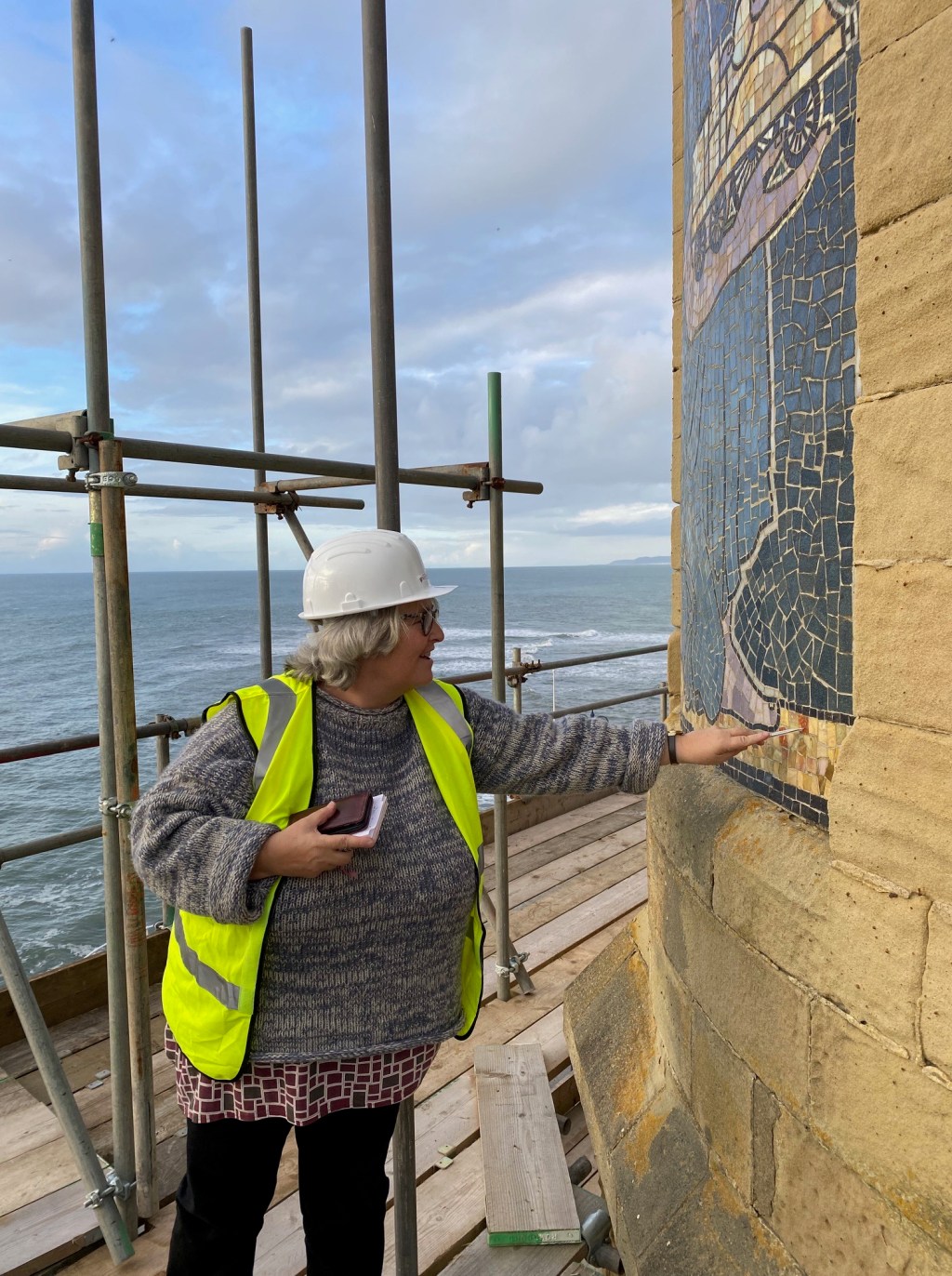
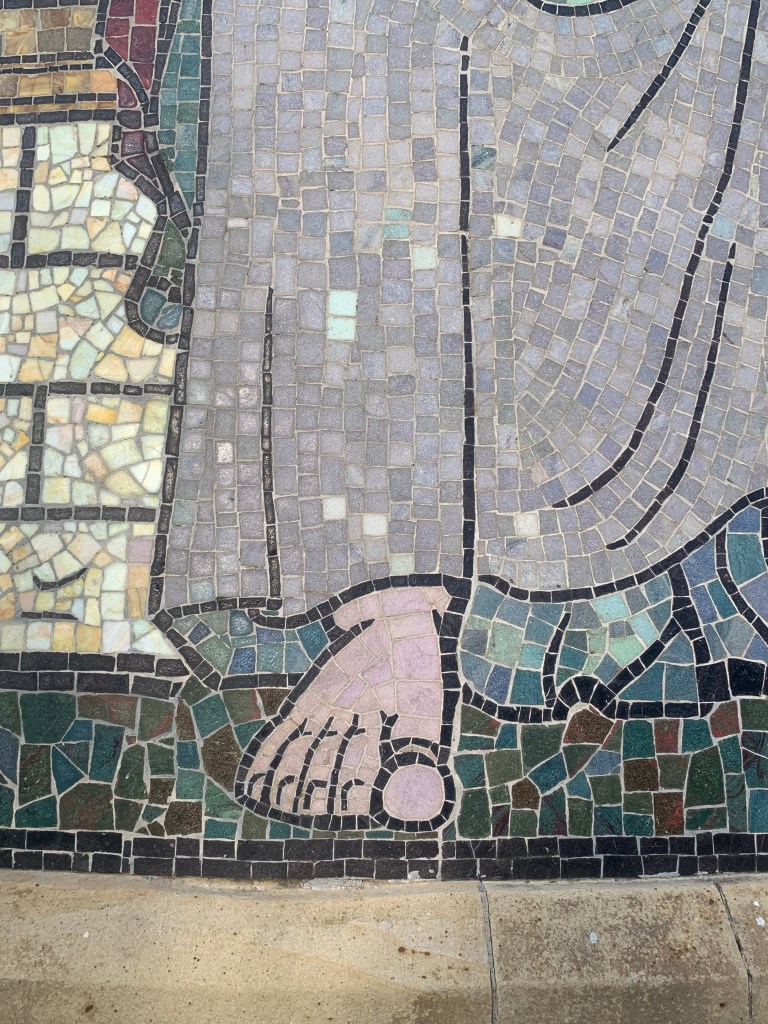
It isn’t everyday you get to look closely at a mosaic you see many times a week; let alone one that is over 9ft high and I dread to think how high from the ground! The restoration of the Old College, Aberystwyth, the largest National Heritage Lottery funded project in the UK, has allowed me to see this Voysey piece, up close and personal. Does Archimedes’ toe need a manicure I wonder?
I have previously written about this mosaic for the Voysey journal, ‘The Orchard’ in 2022 and for the BAMM (British Association of Modern Mosaics) journal and in a blog. What a privilege it was to be able to see this. I got a tingly feeling!
Why is it so important? It is CFA Voysey’s only figurative mosaic and is not included in his white or black book of commissions. Curious. Given this mosaics’ checkered history, it is remarkable that it still is here and can be viewed and what is even more remarkable is that it is still standing over 100 plus years later. I won’t repeat the earlier blog, you will need to hunt it out.
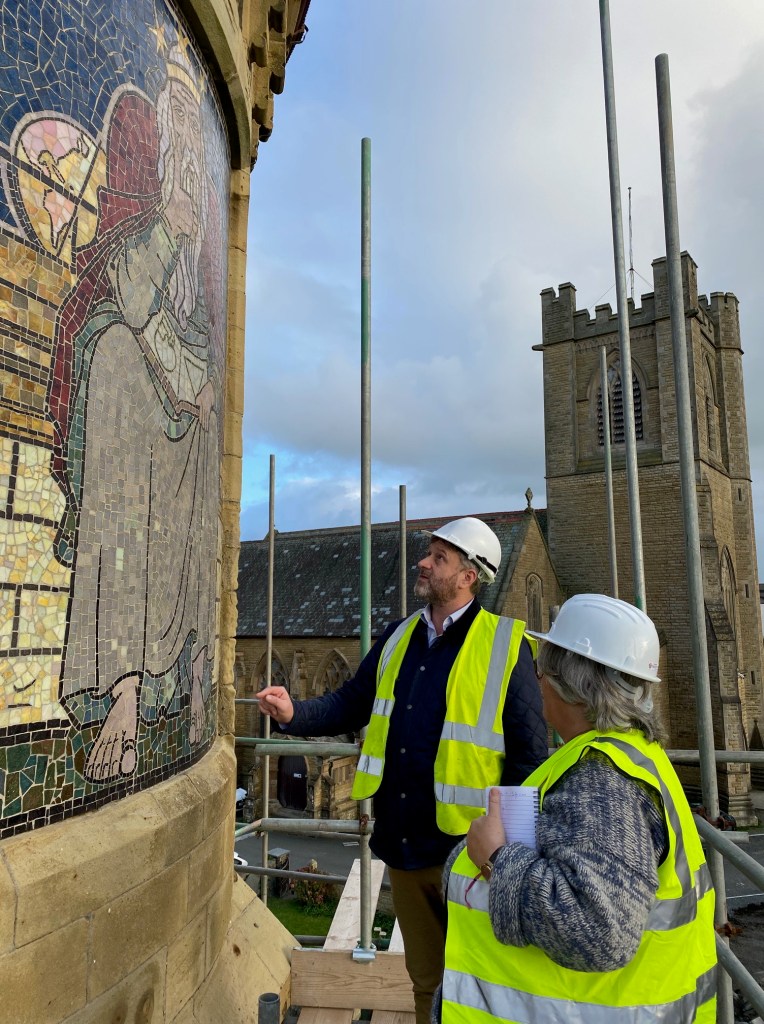
Recent renovations have encased Old College with scaffolding and I was asked to make a inspection report. After all, it will be the only time in my lifetime that scaffolding is on the same level as the mosaic. It makes sense doesn’t it? Glad I did, and overcame my fear of heights.
Will the mosaic last another hundred years? YES!
Armed with a notebook and ruler…I gingerly attempted to climb the exterior scaffolding staircase in over-large boots that felt like lead weighted diving boots, high vis and a fetching hard hat.
What a lovely surprise I had, and how lucky am I to see the real beauty of the piece. I would like to share my findings with you thus far.
Images for reference to text below
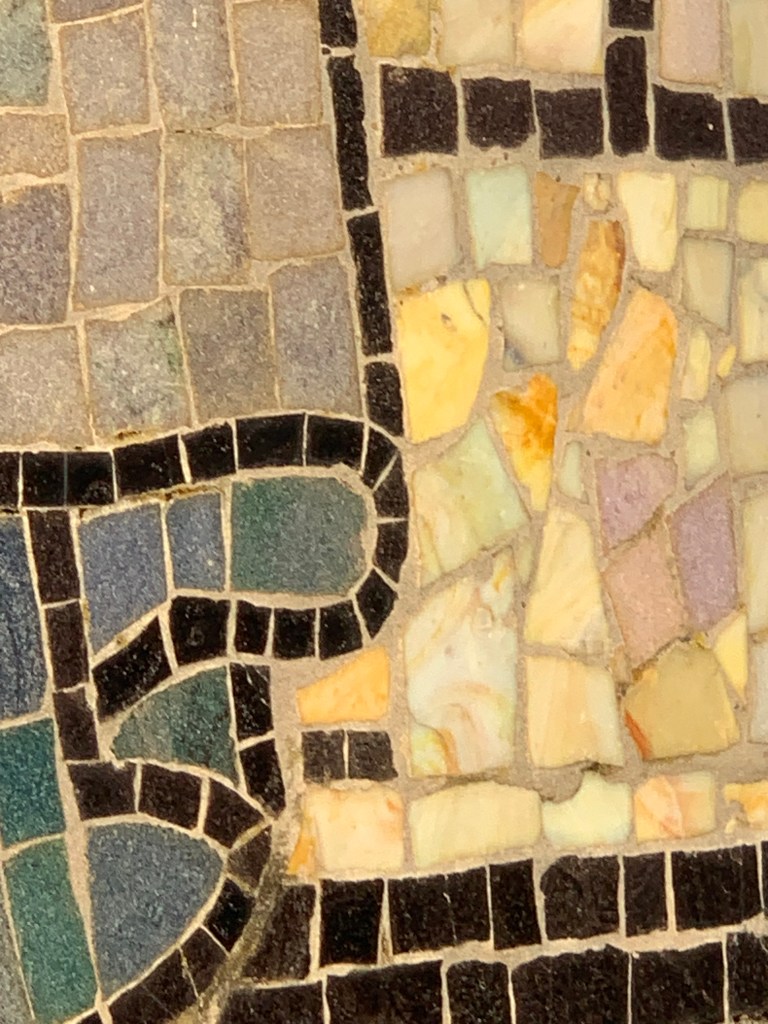
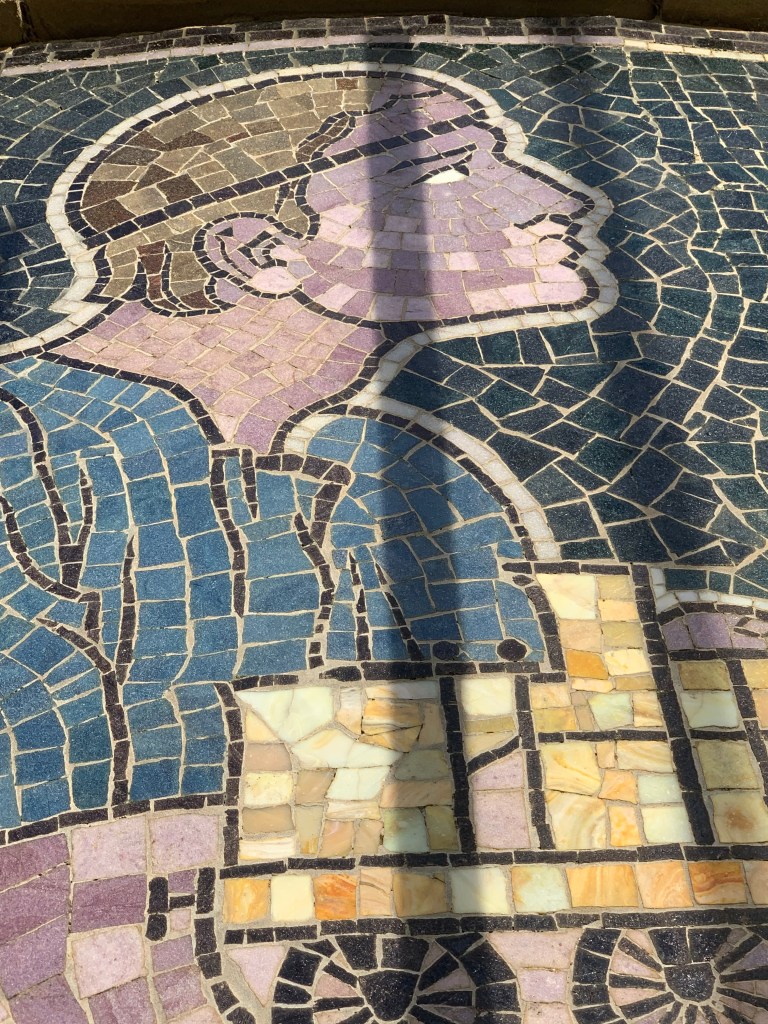
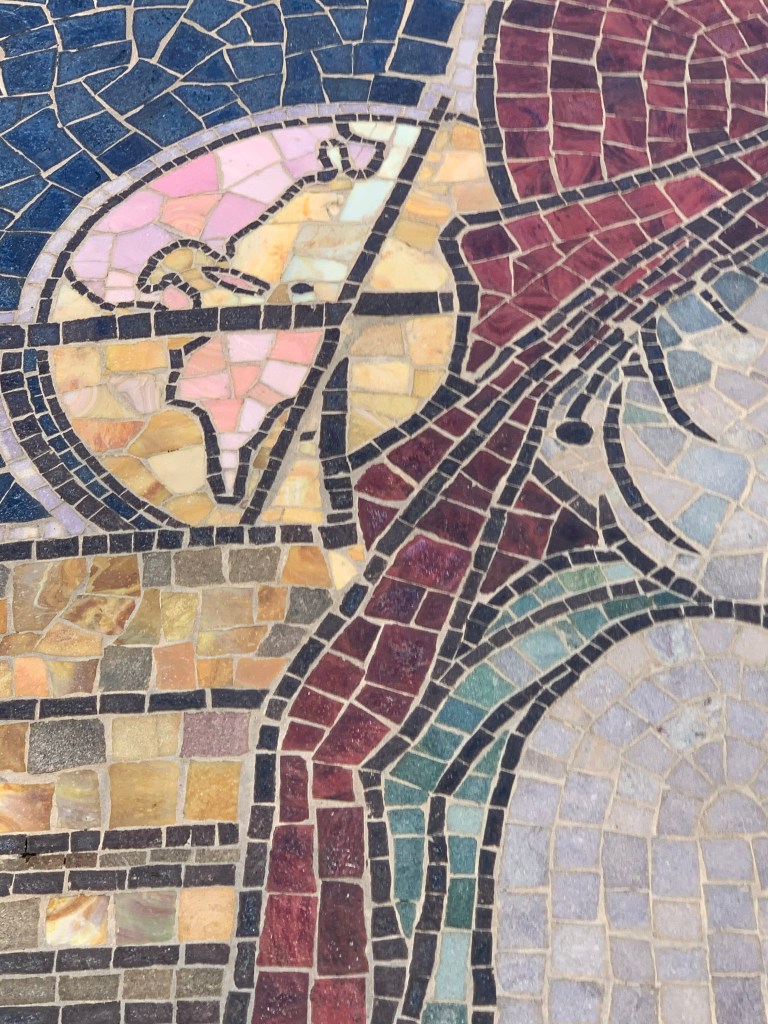
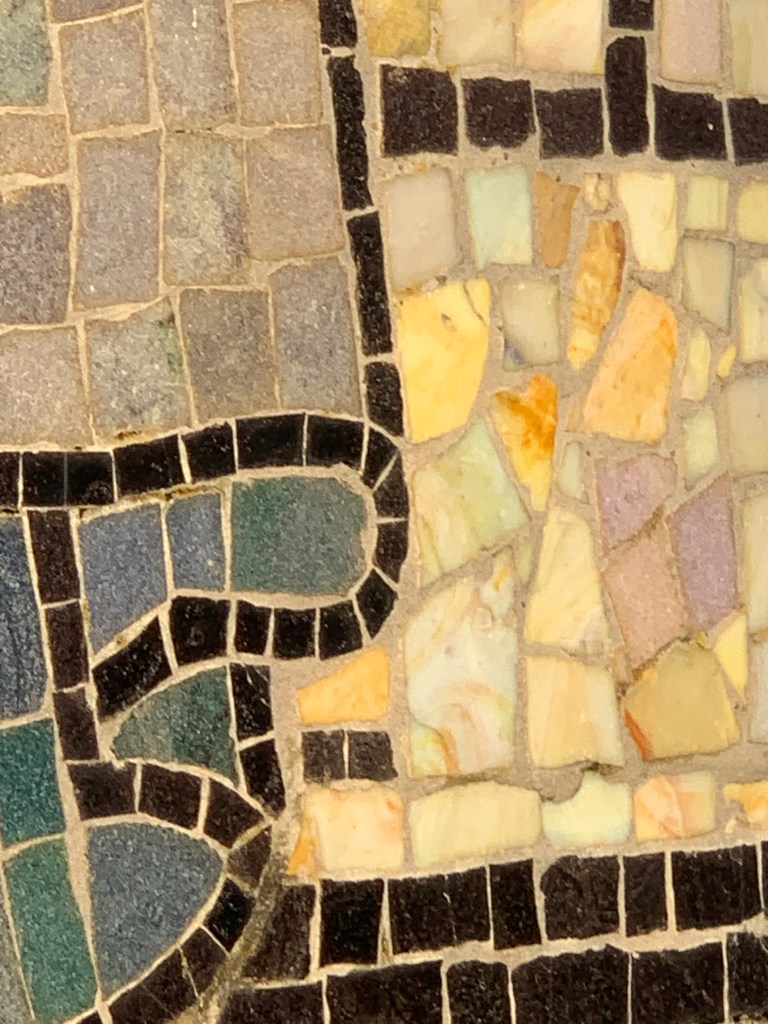
From below, at ground level, the contentious, replaced area below where Archimedes sits, is a very plain yellow, like a brick wall really, but up close I really get an idea of how this mosaic was built up. Jesse Rust’s mosaic (The Vitreous Mosaic Company) tiles were 1/5 cheaper than Italian smalti, but only when seen up close, can you get to see the real beauty of them. I have to admit I thought they were very dull, but not so!
Orsoni or smalti manufacturers today would frown upon the quality of these ‘agate style’ tiles. The tiles or tesserae are tempered because they were made from re-cycled glass and pigments, making them similar in appearance and composition to marble- actually; it was a perfect choice to withstand the salt winds of being on the Welsh coast. They have a similar appearance of Mexican smalti which has strands and whirls of other colours embedded within them. It shows too, that the mosaicist workers were choosing to use the tiles upside down and right way up. Some tiles have a slumped look about them, (skinned) like the fold of skin or sand that has been sculpted by lapping waves.
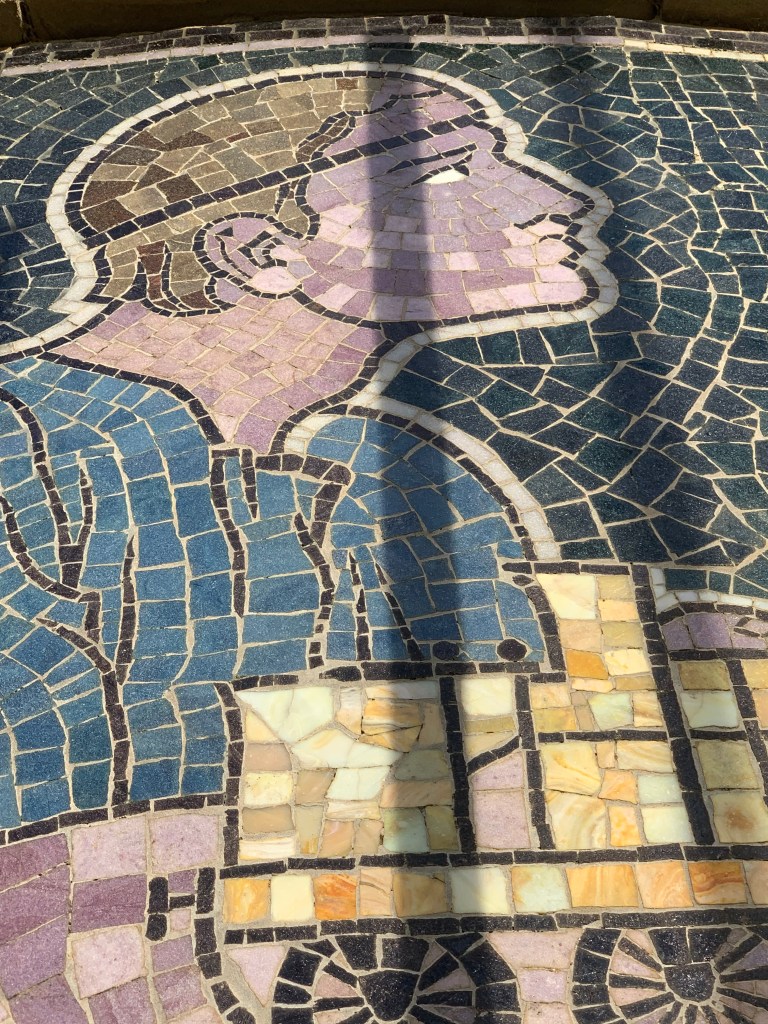
Some tiles have a bubble surface; perhaps over-heated causing a matt appearance. (lower black line) This is a detail of Archimedes books. Had the crucible been too hot?
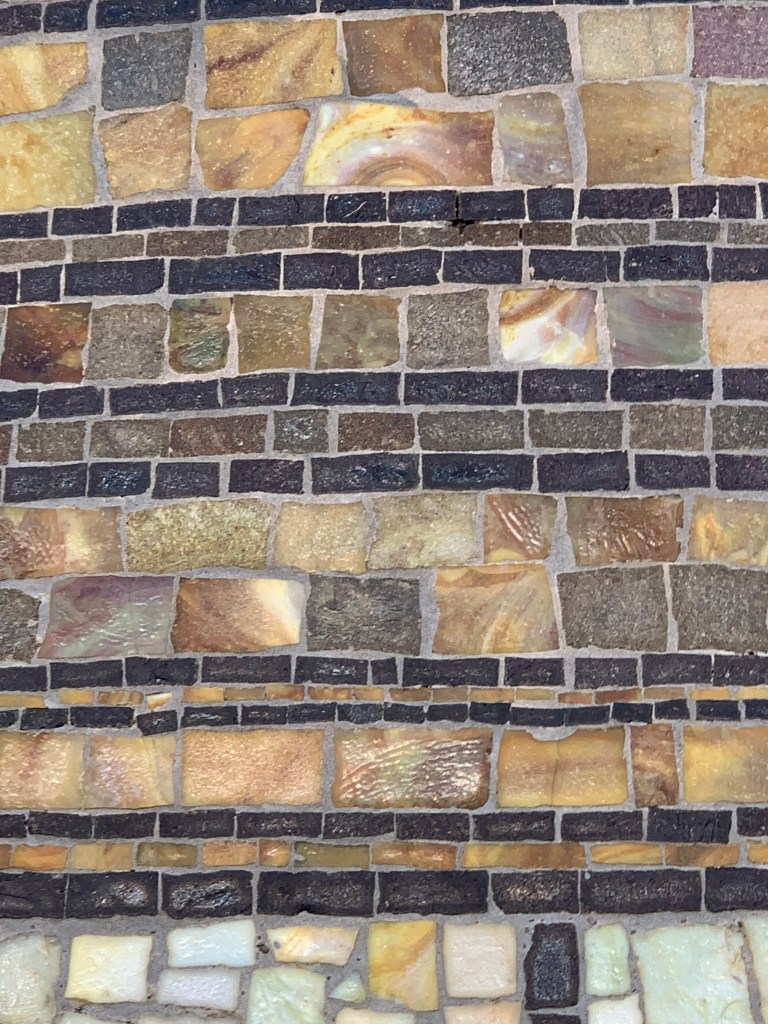
I have always hated those yellow brick tiles but up close they have a real beauty. I also think there are a few of the old tiles within the wall from where the scaredotal images were chipped away. Comparing the original drawings with this, isn’t conclusive, as no images of the middle design are available to compare it with. But, look at the random black lines in the yellow wall by the gown.
Then there is the thorny issue of, have some tiles been replaced or patched? I can confidently say, definitely. The face looks spotted, just a different tone of colour… but when you then look at the inner ear, there is a replacement tile there; the drawing of the ear is wrong / clumsy. Or a tile may have fallen off when attaching it to the wall and a ready supply of tiles the right shape was placed in the shape at the last moment. Note the white of the eye is very white!
Well now, what have I found?
It is really interesting to see the way the mosaicists (I am sure there were many workers) patch up the gaps with small thin lozenge shaped tesserae to accommodate for the curve of the wall. I haven’t got a visual example of that but will take another photo when I return to see the right-hand side figure of the acolyte holding the steam ship. Overall the Opus or flow is consistent throughout using Opus Vermiculatum (worm like flow) to cleverly delineate from the similar toned background on the edges and features of the body. Note there are two shades, a white and a dark. Then Opus Palladium – a kind of crazy paving style of placing the tiles, used very effectively for the background. It is also very interesting to see how thin the interstices (the gaps) are between the tiles. The gaps are filled with grout but you can vaguely see the jig-saw shapes that were required to divide this mosaic up so that it could be attached to the wall. The sheer weight of the tiles stuck on brown paper required the mosaicists to adopt this technique of attaching the mosaic upside down in sections. A massive headache to do!
Then there is this wonderful pink that is used on the globe for the Americas. The Americas demonstrate the advances in Science; the new world. Orsoni state that this is the most difficult colour to achieve as it requires cadmium, sellenium and gold. The recipe is a closely kept secret. Orsoni (located in Venice) were able to create 3,500 colours; these are held in a floating library in Murano. Rust’s library was a fraction of the colour chart but many of the tiles, for instance, the green are swirled with red. Look at the image near the toe.
So how is the mosaic holding up? There is undermining to the grout revealing edges of the tiles, but that can be easily remedied. The activity isn’t dissimilar to re-pointing a house, but it needs to be done. In my opinion. it has been caught just in the nick of time.
I’m so looking forward to see the upper half of the mosaic and the left figure – purportedly to be a portrait of Voysey himself. So far I think the right-hand figure has faired better from the salt winds, but let’s see.
Finally, a big thank you to Kim Kenobi for a hilarious hour in 2021, standing at the base of the tower, working out the size / height / dimensions of the mosaic with mathematical equations based on a coining stone. There was no record of the dimensions of this creation so it was important to get it measured, 8ft 4 inches. You were pretty close.
I will write another post after my next visit.


Leave a comment